Safe, Affordable, Necessary & Effective Vaccines and Vaccination Practices
August 29, 2013
By Norma Erickson
Are acute disseminated encephalomyelitis (ADEM) and Guillain-Barre Syndrome (GBS) adverse reactions to HPV vaccines? Health authorities in Japan are not sure at this point, but they have chosen to apply the precautionary principle and inform medical consumers just in case.
On March 26, 2013, the Japanese Ministry of Health, Labor and Welfare informed GlaxoSmithKline they had 30 days to alter the package insert for Cervarix by adding the following to the Precautions/Adverse Reactions section:
Acute disseminated encephalomyelitis (ADEM): Acute disseminated encephalomyelitis (ADEM) may occur. In such cases, pyrexia, headache, convulsion, movement disorder, and disturbed consciousness, etc., generally occur within several days to 2 weeks after vaccination. If ADEM is suspected, diagnosis should be made by MRI etc., and appropriate measures should be taken.
Guillain-Barre syndrome: Guillain-Barre syndrome may occur. If any symptoms such as flaccid paralysis originating from the distal extremities, decreased or absent tendon reflexes, appropriate measures should be taken.
The directive was not addressed to Merck because the package insert for Gardasil already had a reference to the risks of ADEM and GBS at the time of the directive’s issuance.
The reason for this action? During the first three years of using HPV vaccines, 3 cases of ADEM and five cases of Guillain-Barre Syndrome had been reported after Cervarix injections for which a causality to the drug could not be ruled out.1
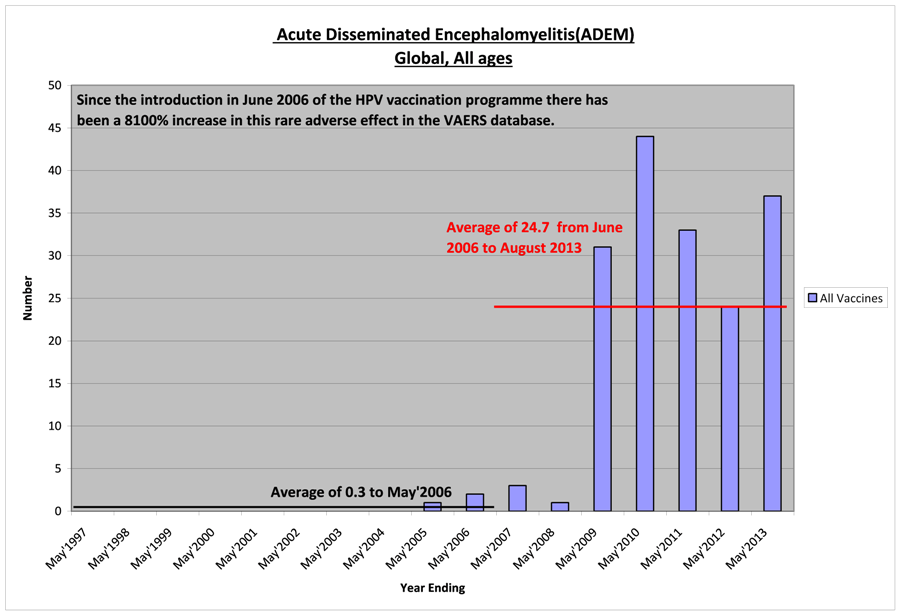
As a point of reference, there have been 31 cases of ADEM and 121 reports of Guillain-Barré Syndrome filed with the United States VAERS (vaccine adverse event reporting system) after HPV vaccinations2 during the last seven years. The FDA has made no request that these conditions be added to the package inserts. What is wrong with this picture?
How many reports of ADEM or GBS have been filed in your country after HPV vaccinations? Has your government health officials required any modifications to the HPV vaccine package inserts?
Why did Japan take this bold step?
At first glance, the Japanese ministry’s action may give the impression that they acted on their belief in the principle of informed consent.
However, Toshie Ikeda, secretary general of the Nationwide Liaison Association of Cervical Cancer Vaccine Victims and Parents in Japan and Dr. Sotaro Sato, director of the Sato Cardiovascular Internal Medicine Hospital in Osaki, Miyagi Prefecture, believe the ministry’s action requires deep analysis. Two motivations appear to be behind their move, with one outweighing the other.
They said the first possible motive is a sincere desire to make medical doctors and other intellectuals aware of the essential nature of severe adverse effects of the HPV vaccines, Gardasil and Cervarix, in order to prevent further cases of severe damage to the health of millions of teenage girls who would otherwise be administered injections of the two vaccines during coming years.
The other possibility is fear of potential lawsuits being filed by the association on behalf of numerous desperate families whose beloved, previously healthy daughters have been seriously impaired, paralyzed or horribly devastated by HPV vaccinations. Japanese courts would be likely to find health bureaucrats responsible for the serious adverse effects inflicted on the girls if they did not take precautionary measures beforehand and leave some evidence that could later be used to prove they had at least tried to do something to block the further spread of health impairments to upcoming generations of teenage girls. This would be a particular problem if the government moves to reinstate their recommendation of these vaccines during the current fiscal year ending on 31 March 2014, due to pressure from politicians and academics with financial ties or other links to the vaccine manufacturers, lobbying activities, and consulting ‘experts’ hired by the manufacturers.
You see, under Japanese law bureaucrats found to have neglected their duty to inform medical consumers of serious risks involved with taking medicines, vaccines and other medical products can be prosecuted and severely punished.
A high-profile precedent was established in 2008, when the Supreme Court upheld a Tokyo High Court ruling imposing a sentence of one year imprisonment on former senior ministry bureaucrat Akihito Matsumura¸ with a two-year stay, for neglecting his obligation to order pharmaceutical companies to stop selling unheated blood coagulants contaminated with the AIDS virus.
Chief Justice Yuki Furuta, of the nation’s top court, stated in the decision issued on March 3:
“Unheated blood products in this case were being used widely at the time of this (infection) incident and the products included a sizable number of products contaminated with the AIDS virus. The accused could have foreseen that if the products were used, numerous people would nearly inevitably get infected with the virus and develop the AIDS, causing many of the users to die eventually.”
Ikeda, who spearheaded the association, is currently being assisted by some of Japan’s best medical scientists, some politicians with strong morals, and intellectuals concerned about the fate of numerous teenage girls who have been victimized, or may be victimized in the future, unless the HPV vaccination policy is discontinued. She stated Saturday:
“It is still unknown which motivation was the bureaucrats’ primary concern when they demanded the revision of the package insert on March 26. The movements of the association have been closely monitored by the health ministry’s bureaucracy.”
Dr. Sato stated Friday he is also aware of the two possible implications of the directive issued by the ministry. He said:
“It is truly commendable that some conscientious bureaucrats at the ministry appear to have made serious efforts to alert relevant people with the directive and instruct pharmaceutical manufacturers to add references to a possible outbreak of ADEM and GBS to their package inserts. But, bureaucrats’ desire to avoid being held responsible by courts at a later date for neglecting their supervisory and regulatory duties; thus increasing the number of victims appears to have played a greater part in motivating the ministry to issue the directive.
The revision to the package inserts would make a meaningful difference, if a lawsuit were filed down the track. With the issuance of the directive, bureaucrats would be able to tell victims, parents and their supporters that the ministry had issued an important warning on possible adverse effects and that the victimized are therefore responsible, as they simply did not notice the reference to the risks thus included in the insert.”
Dr. Sato called attention to the coincidental dates: with the association holding the first meeting of vaccine victims and their parents on March 25 – one day before the issuance of the directive. The ministry must have been following a string of events leading to the establishment of the association for which people of good intentions joined forces to free victims from their agony and prevent the drug manufacturers, medical associations and government from producing more victims, whether unintentionally, through half-awareness and knowledge of adverse events, or due to callous indifference to possible serious consequences of HPV vaccines on girls’ health.
Dr. Sato called attention to another key dimension of the HPV vaccination issue now being faced by numerous doctors in Japan and elsewhere, when he stated:
“When a doctor sees a girl who developed various symptoms caused by ADEM or GBS following vaccination, he or she would not be able to recognize the symptoms as those resulting from ADEM or GBS unless that doctor had deep knowledge of neurological disorders or diseases. It is not easy for doctors to associate symptoms they are seeing with ADEM or GBS. In Japan, the percentage of doctors who can recognize the symptoms of girls who one day come to see them as consequences of ADEM must be less than 0.1 percent of our doctors’ population.”
Government authorities need to draw up and issue unified diagnostic criteria to help doctors recognize symptoms induced by ADEM and GBS as such and call the attention of doctors to said criteria. Most doctors who may see vaccine-ravaged girls in the future must be made familiar with the symptoms.
Dr. Sato warned:
“Merely getting drug makers to alter the package insert is not adequate to increase the awareness of doctors and medical consumers of the potential risks of these two vaccines. Unless the government makes very serious efforts to direct attention to the possible horrible adverse effects of these vaccines, it is likely many doctors will continue administering injections of the vaccines without being able to pay necessary levels of attention to the causal link between the vaccines and their adverse effects.”
Japanese politicians speak
28 March 2013, a select Committee for Health, Welfare and Labor held a special session so questions about HPV vaccines could be addressed prior to a parliamentary vote on whether to add three diseases, cervical cancer being one of them, to the list of vaccines whose cost should be fully covered by the government under the nation’s existing Preventive Vaccination Law.3
Of the 722 members of Japan’s Parliament, two voices have repeatedly questioned the sanity of universal HPV vaccinations in Japan, particularly strongly both on the parliamentary floor and via the mass media. One voice was Ms. Tomoko Hata, Member of Parliament, but not a member of the Committee for Health, Welfare and Labor. The other was that of Mrs. Eriko Yamatani, a former aide to Prime Minister Shinzo Abe. Abe’s Liberal Democratic Party toppled the leftist-dominated Democratic Party of Japan in a general election for the House of Representatives, the more powerful of Japan’s bicameral parliamentary system, only on December 16, 2012, with Abe assuming the premiership on December 26.
Ms. Hata made sure those present at the question and answer session were made aware of the following facts about HPV and cervical cancer in Japan:
- The proportion of Japanese women who carry HPV types 16/18 is much lower than women in western countries. (0.5% for HPV 16 and 0.2% for HPV 18)
- More than 99.1% of the carriers of human papillomavirus will not get cancer.
- 90% of those exposed to HPV will discharge/clear the virus in 2 years.
- 90% of those who develop very early signs of cervical cancer (cervical dysplasia) will recover spontaneously.
- The number of serious adverse effects reported was 52 times greater after Cervarix than reports after flu vaccinations; 26 times higher after Gardasil than after flu vaccinations.
The same day, Japan’s Parliament voted to include cervical cancer in the list of vaccines that are fully subsidized by the government under the law. Hata voted against the proposed inclusion, while Yamatani and a few others abstained on the vote.
Four years earlier, on October 16, 2009, the government of Japan, which was still under the control of the leftist DPJ-led government approved the sale of Cervarix in Japan. Then, on February 1, 2011, the government began spending taxpayer money via a partial subsidy program, under which the cost of HPV vaccines was split between the central government and local prefectural governments across the nation. Under this program, the central government put up 15 billion yen under the “emergency promotion program.” After the subsidy program was put in place, the marketing of Gardasil was approved on July 1, 2011. The DPJ-led government and the health ministry jointly adopted a policy of fully subsidizing the vaccines on May 23, 2012, despite the fact they were aware of reports of outbreaks of numerous cases of adverse reactions among recipients. This was followed by a change of power last December.
Since the coalition government of Abe’s LDP and the New Komeito Party, as well as opposition parties overwhelmingly voted to start fully subsidizing HPV vaccines on March 28, 2013, the government set aside 100 billion yen for the fiscal year that started on April 1st.
Because the LDP-led government took over the health ministry’s bureaucracy, which had cooperated with the DPJ-led government, it also took over the agreement to fully subsidize HPV vaccine administration. The new administration found it difficult to correct and jettison the wrong policy while the vaccine manufacturers continued to lobby to preserve the full subsidization policy through various channels and connections with powerful political circles.
Cervical cancer vaccine victims and parents organize
Meanwhile, victims of serious adverse reactions throughout Japan organized under the Nationwide Liaison Association of Cervical Cancer Vaccine Victims and Parents. Through the collection of adverse event reports from individuals (see link to chart below[4]), they began to understand that the officially reported adverse events were merely the ‘tip of the iceberg.’
This organization is currently petitioning government health officials to:
- Ban the use of HPV vaccines in their country and acknowledge HPV vaccine injuries
- Establish treatment for HPV vaccine victims
- Provide financial relief for HPV vaccine victims
- Investigate all who have been inoculated with HPV vaccines
- Include the nation’s top neurological scientist, who saw dozens of victims, in a health ministry committee on the fate of the vaccines
Japan suspends HPV vaccine recommendation
The Nationwide Liaison Association of Cervical Cancer Vaccine Victims and Parents has apparently made an impression on their government health officials.
In an unprecedented move, less than three months after pushing legislation through Parliament granting full subsidization of HPV vaccines, government officials in Japan suspended that recommendation pending the outcome of investigations into the safety of Gardasil and Cervarix.5, 6
On the same day the HPV vaccine recommendation was suspended, 14 June 2013, the health ministry issued another directive to the chairman of the committee on safety of medicines at the Federation of Pharmaceutical Manufacturers’ Association of Japan in the name of Tomiko Tawaragi, Director of Safety Division, Pharmaceutical and Food Safety Bureau.7 This letter required the manufacturers of Gardasil and Cervarix to add the following to the ‘Precautions’ section of their package inserts within the next 30 days:
“Although the mechanisms of pathogenesis are unclear, severe pain which is not localized at the injection site (e.g. muscle pain, arthralgia and skin pain, etc.), numbness, weakness, etc., may occur after vaccination and these symptoms may persist for long time. Vaccine recipients and their guardians should be instructed to consult a healthcare provider who can provide appropriate medical care including making neurological and immunological differential diagnosis if any abnormalities are observed after vaccination.”
Please note, the paragraph above instructs vaccine recipients and/or their guardians to consult a physician if ANY abnormalities are observed after vaccination. Have medical consumers in your country been made aware of these possible adverse reactions?
Japan’s actions raise questions for medical consumers worldwide
1) Do your health authorities believe in the right to informed consent?
2) Will the risks associated with HPV vaccines be explained, as well as the benefits?
3) Will alternative cervical cancer preventive measures be explained?
4) Will the risk factors for developing cervical cancer be explained?
5) Do health authorities in your country understand what adverse effects are possible after HPV vaccines?
6) Are your healthcare providers trained to recognize these events as possible vaccine reactions?
7) What happens if you experience an adverse reaction to an HPV vaccine?
Think about it – if HPV vaccines are as good as they should be, all of these questions should be easy to answer. You have a right to know. It is called the right to informed consent.
What is more important to you – vaccine safety, or vaccine uptake?
French translation of this article here.